
Welcome to Part 1 of my CSDM5 deep-dive series!
CSDM isn’t just a diagram—it’s the backbone of ServiceNow value realisation. The May 2025 Final release brings critical updates that every ServiceNow professional needs to understand.
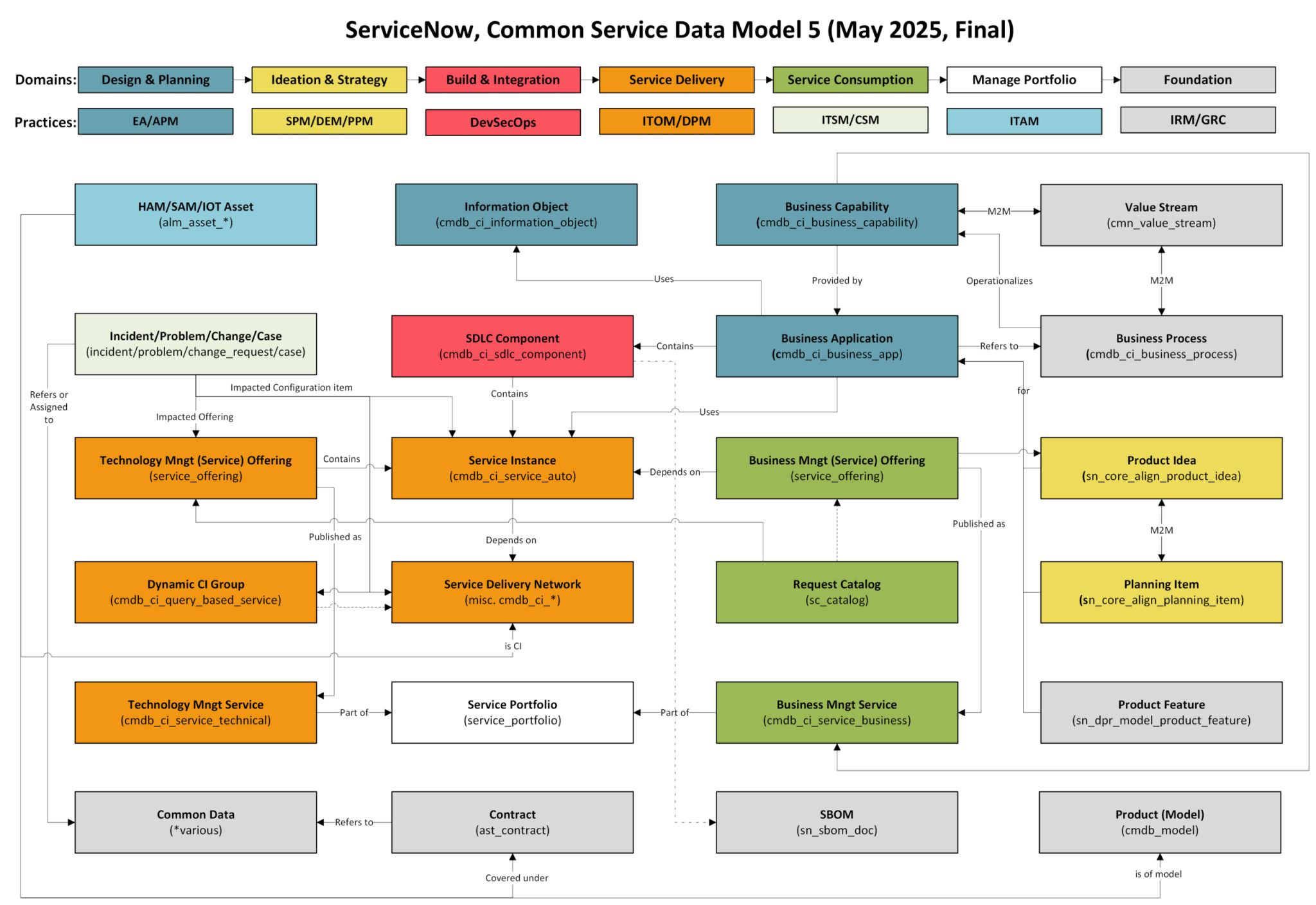
What you’re looking at:
- ✅ The complete CSDM5 architecture spanning 7 domains - from Design & Planning → Foundation
- ✅ Each practice (EA/APM, SPM/DEM/PPM, IRM, ITOM, SecOps, etc.) is aligned to domains
- ✅ The relationships between Business Capabilities, Applications, Services, and Assets
Why this matters:
- ❌ Without proper CSDM implementation: Siloed data, duplicate records, poor reporting
- ✅ With CSDM done right: Single source of truth, automated workflows, actionable insights
Coming up in this series:
- 💡 Business Capabilities → Value Streams
- ⚙️ Service Offering vs Service Instance
- 🧩 SDLC Components in action
- 📊 Portfolio management links
Part 2: Moving from Crawl to Run
Making CSDM 5 Work in the Real World
Too many organisations think they’re “doing CSDM” because they built a few Business Applications or imported discovery data.
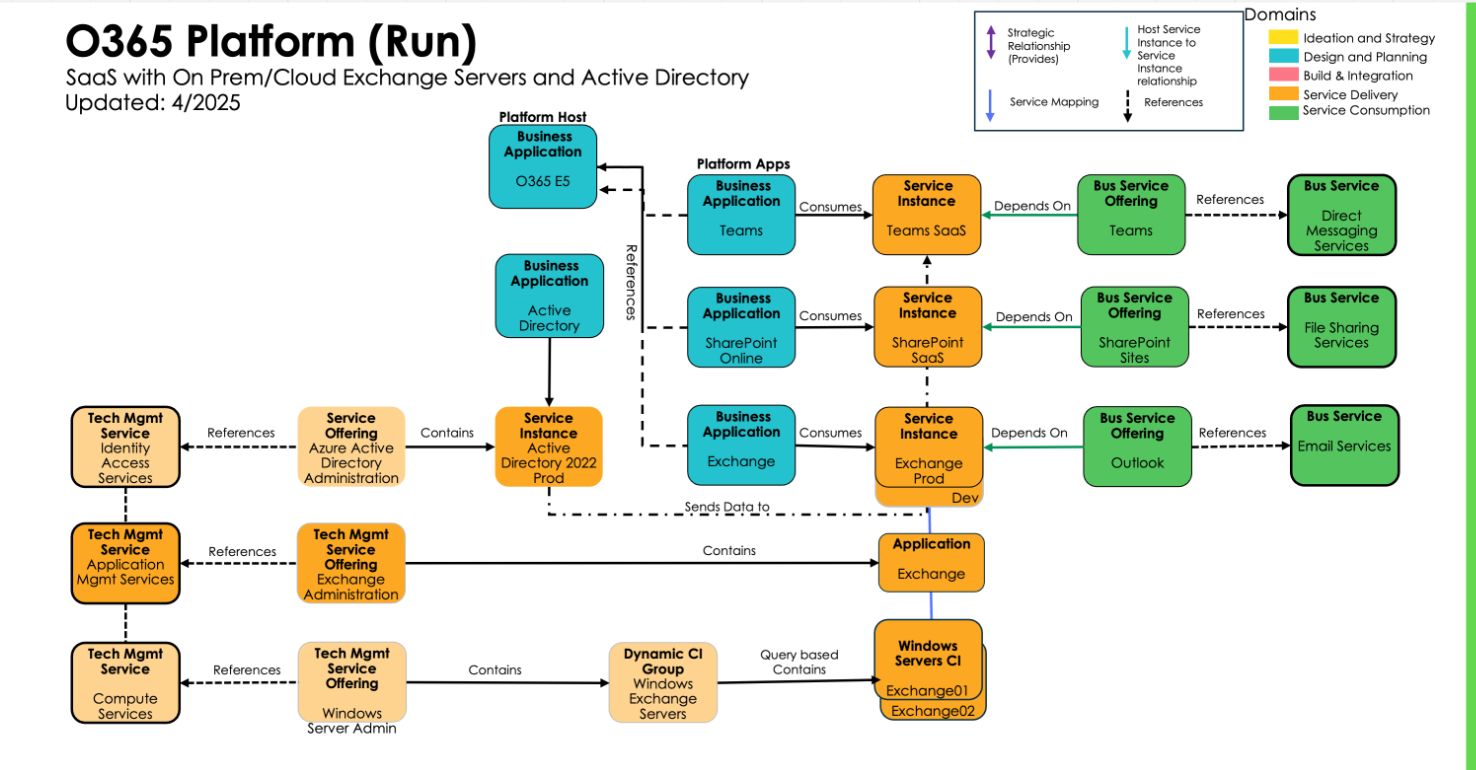
The Crawl→Walk→Run Reality
🐾 CRAWL: Business Applications & Service Instances
- Business Applications = application portfolio (not used in tickets)
- Service Instances = running instances (prod/dev, regional)
- Incidents reference Service Instances
Value: Foundation for ITSM, EA, Service Mapping, DevOps
🚶 WALK: Technical Service Management
- Technology Management Services = who manages the technology
- Technical teams formalise service offerings (environments, support tiers)
- Metadata is synchronised automatically across managed CIs
Value: Technical ownership + Service Portfolio Management foundation
Key: This is about technical service providers, not customer-facing business services yet.
🏃 RUN: Business Services & Impact
- Business Services = strategic business value (what the business sells/consumes)
- Business Service Offerings = service commitments (availability, pricing, SLAs)
- Technology services underpin business services through relationships
Value: Impact analysis shows business services affected + ITSM+ identifies who is impacted
Key: You manage CIs AND services - now answer “what business services are impacted?” not just “what servers are down?”
The Progression
- Crawl: “What application is affected?”
- Walk: “Which technical team manages this?”
- Run: “What business services are impacted and who is affected?”
Both chains converge at Service Instances - this is why the Crawl stage is foundational.
Use Service Mapping and Discovery for automation. Manual relationship management doesn’t scale.
Common Mistakes
- ❌ Skipping Walk - technical service management is critical
- ❌ Creating Business Services too early - meaningless without Service Instances
- ❌ Confusing Business Applications with Business Services
Run Maturity Value
- ✅ SLA breaches link to business services and subscribers
- ✅ Change impact visible before implementation
- ✅ AI prioritises by business criticality
- ✅ Executives see IT in business language
- ✅ Service Portfolio Management visibility
The Bottom Line
CSDM maturity is not about having data in tables. It’s about ServiceNow processes running on that data to deliver business value.
That’s the real transformation: ServiceNow is evolving from a ticketing system into an AI-powered business operations platform that manages services and their business impact.
Part 3: AI Control Tower doesn’t fix messy data
It exposes it.
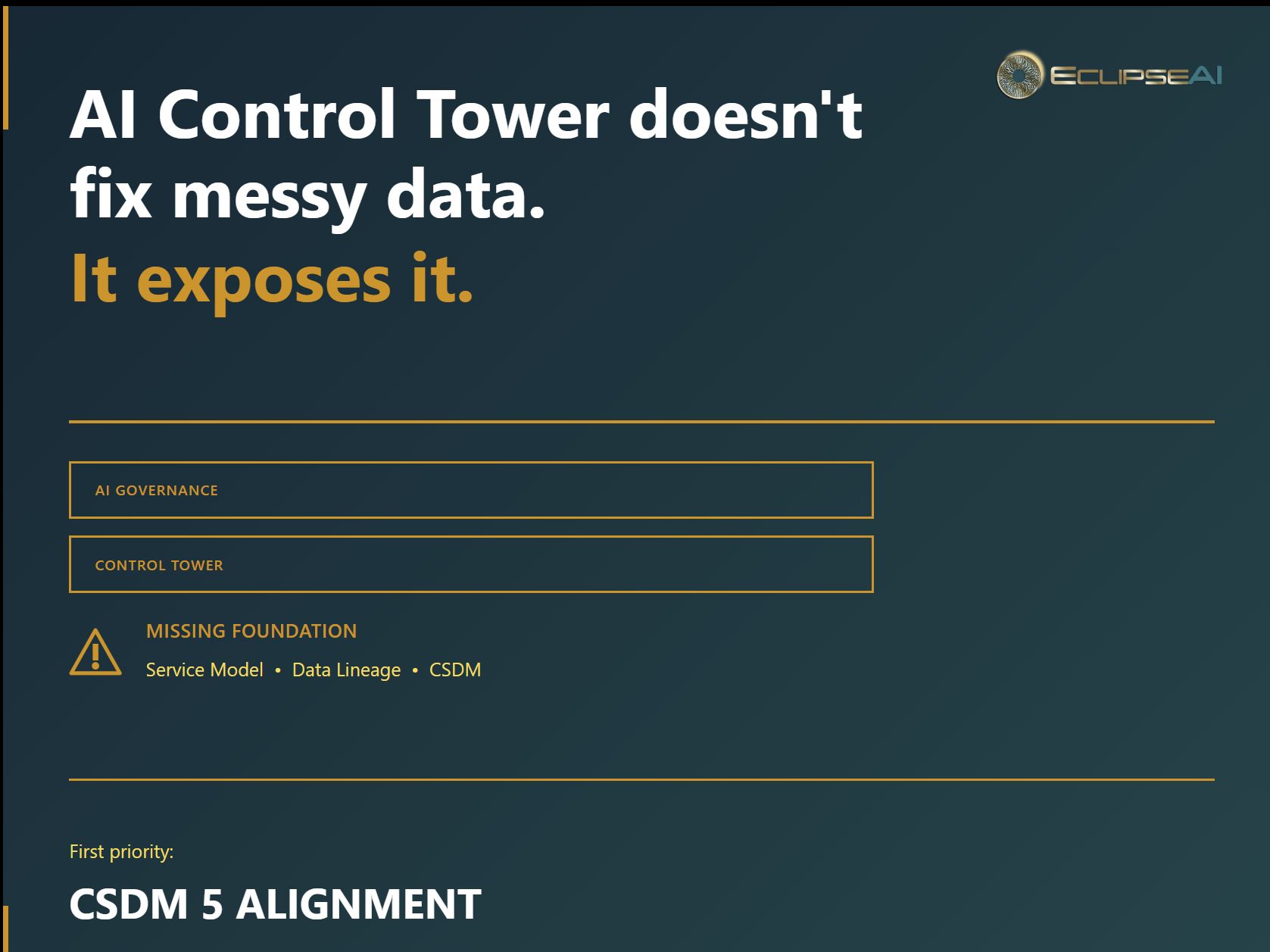
I’ve now seen 3 AI Control Tower deployments stall in the last few months for the same reason: The customer data wasn’t aligned to CSDM5.
🚦 If you can’t answer these four questions in under a minute:
- ✅ Which service does this model impact?
- ✅ Who owns it?
- ✅ What’s its criticality?
- ✅ Where’s the approval trail?
You’re not ready for Control Tower.
It’s CSDM 5 alignment.
Everyone wants AI governance dashboards. Nobody wants to fix the data foundation first. But here’s the reality:
- ❌ If your service relationships are broken, Control Tower can’t map model impact
- ❌ If ownership isn’t defined, approvals go nowhere
- ❌ If lineage doesn’t exist, you fail audits before you begin
Why CSDM 5 is non-negotiable for Control Tower success:
- Governance routing → Approvals only work when service owners are defined
- Risk scoring → Criticality + data sensitivity live in CSDM5
- Lineage & traceability → AI Asset → Application Service (Service Instance class) → Business/Tech Service Offering → Business/Tech Service
- Audit readiness → No service context = no audit trail
Where ISO 42001 fits in
ISO 42001 is the foundation for demonstrating controls on the ServiceNow Platform.
To comply, organisations must demonstrate:
- Ownership & accountability for every model
- Business impact and risk classification
- Traceability from model to business service
- Evidence of governance decisions and approvals
You cannot do this without a service context, and that only exists with a CSDM-aligned service model.
No CSDM → No model lineage → No ISO 42001 compliance foundation.
Part 4: The Critical Distinction
CSDM5 vs Infrastructure CMDB
What Infrastructure CMDB Delivers:
💻 “Which servers failed and which other servers depend on them?”
- 🔹 Root cause analysis
- 🔹 Technical troubleshooting
- 🔹 Infrastructure dependency mapping
- 🔹 Automated service mapping
- 🔹 Technology risk assessment
What CSDM5 Delivers (Even Without Complete Infrastructure):
🎯 “Which business outcomes are at risk and which executives need to know?”
- ✅ Business impact quantification (revenue, customers, users)
- ✅ Stakeholder identification and notification
- ✅ Executive communication
- ✅ Strategic portfolio decisions
- ✅ Service-level accountability
- ✅ Regulatory compliance
- ✅ Customer relationship management
- ✅ Financial planning and optimisation
Quantified Business Value Examples
Scenario: Organisation with mature CSDM (Run/Fly stage) but limited Infrastructure CMDB (40% discovery coverage)
Value delivered through CSDM alone:
- 💰 Service Portfolio Rationalisation: £3.7M annual savings (duplicate app elimination via EA)
- 🔁 Customer Retention: 13% improvement, £1.2M revenue protected (CSM service-level management)
- ⚖️ Regulatory Compliance: £1.4M fine avoided (FCA Important Business Services identification)
- 🎯 Strategic Alignment: £2.6M investment reallocation from low- to high-value capabilities
- ⚡ Incident Prioritisation: 23% reduction in business-critical downtime (impact-based prioritisation)
- 🧭 Service Provisioning: 70% faster provisioning, £1.1M operational efficiency
- 🏛️ Executive Confidence: Board-level visibility enabling data-driven decisions
Total Quantified Value: ~£10.4M annually + strategic advantages
Investment to improve the Infrastructure CMDB:
🔧 £2M (Discovery licences, Service Mapping, professional services, 12–18 months)
The Value Asymmetry
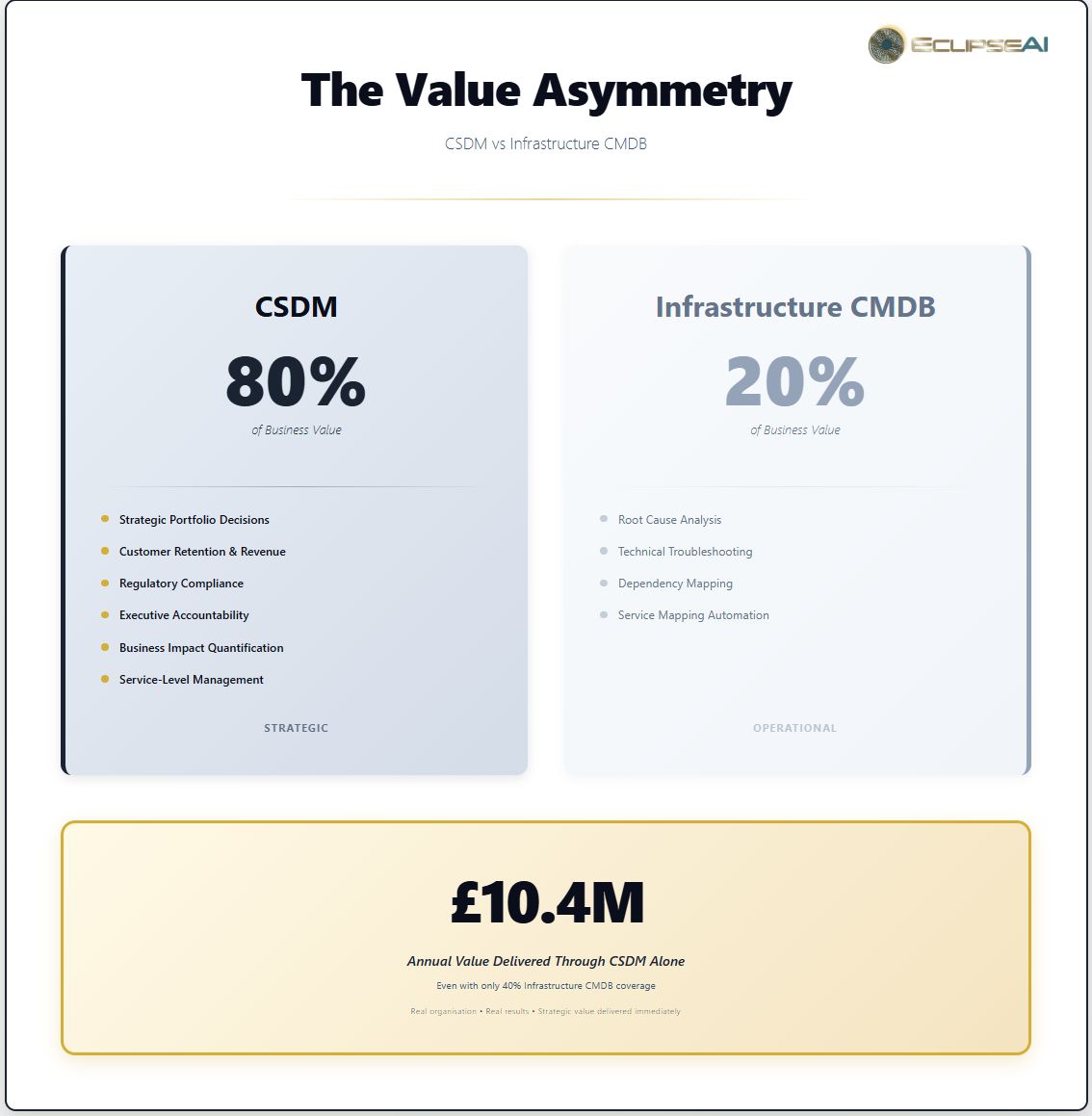
CSDM5 delivers roughly 80% of business value (Strategy, compliance, customer management, portfolio optimisation)
Infrastructure CMDB provides about 20% (Operational troubleshooting, technical automation)
Yet conventional wisdom still claims: “You must have a mature CMDB first.”
Reality: Transformation begins with CSDM5. Infrastructure maturity can follow—it enhances, not defines, business value.
Part 5: You Don’t Need Perfect
You Just Need Crawl
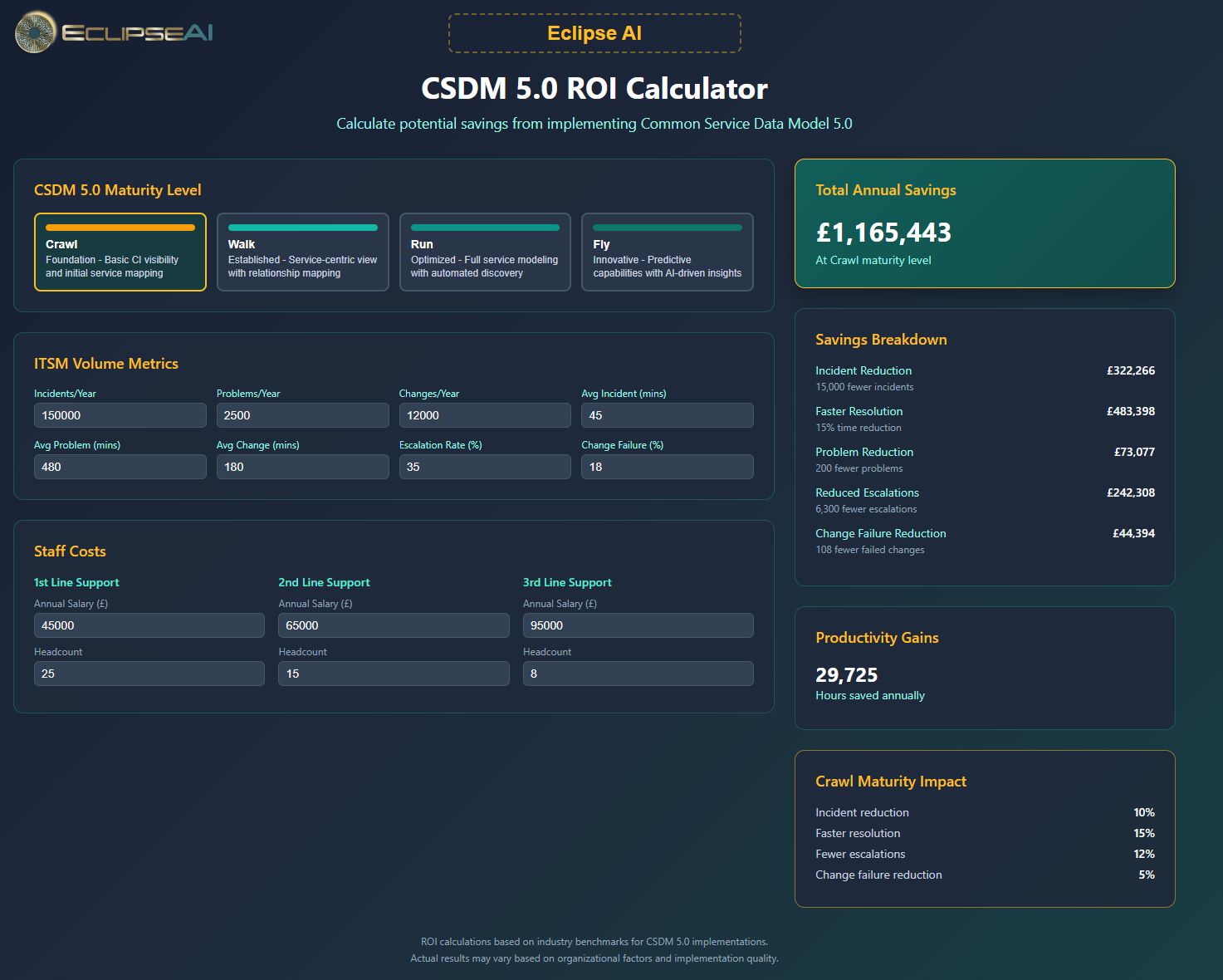
The main question I get from clients is: “Why should I care about the CSDM5? What benefit does it actually bring?”
Here’s what I tell them: Forget perfection. Forget the five-year transformation roadmap. Just get to Crawl.
Most organisations don’t realise this, but you don’t need full CSDM maturity to see massive returns. You don’t need every relationship mapped. You don’t need complete discovery of your entire estate.
You just need one thing: the abstract layer.
The Crawl Solution: Create the Abstract Layer
Here’s what changes when you implement embryonic Crawl maturity in the CSDM:
You create two simple entities that connect business language to technical reality:
1. Business Application: “SAP S/4HANA ERP”
This is what your Enterprise Architect, procurement team, and rationalisation efforts work with. It’s the application-level view that everyone in the business recognises. One entry. One name. Easy for users to understand. Think of this as the “business card” for the application: what it’s called, who owns it, what business capability it supports, and what it costs to maintain.
2. Service Instance: “SAP S/4HANA ERP Prod EMEA”
This is the actual running instance in your environment. It’s married to the Business Application above and connected to the infrastructure below.
That’s it. That’s Crawl maturity.
You’re not mapping every relationship in your estate. You’re not implementing full-service catalogues. You’re not doing complex dependency modelling or multi-tier application architectures.
You’re just creating the bridge between technical reality and business language.
Part 6: CSDM Powers All Cross-Enterprise Workflows
Not Just Platform Services
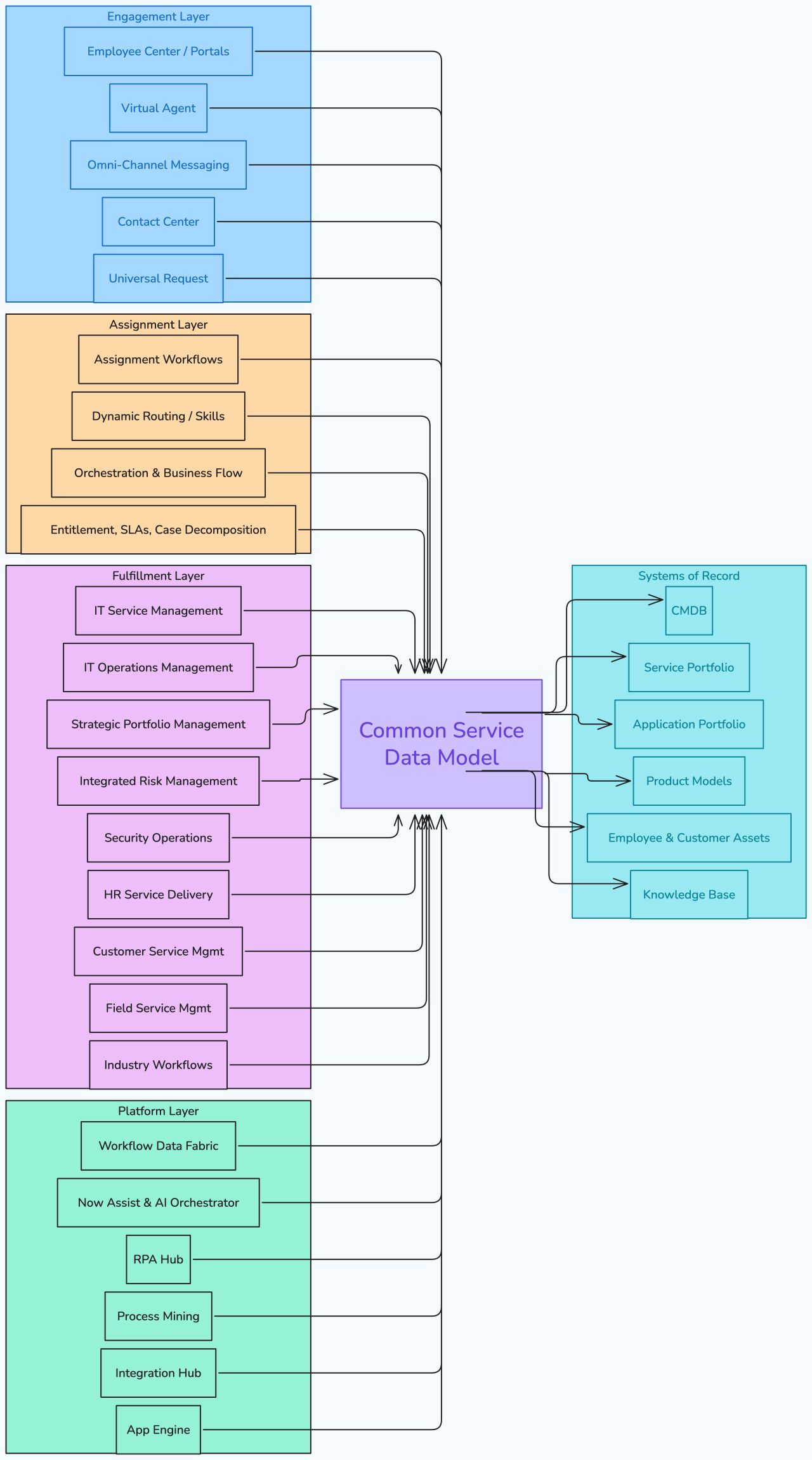
Here is a concise explanation of why CSDM underpins the enterprise workflow stack.
CSDM is not just a CMDB model or governance layer. Every workflow layer—Engagement → Assignment → Fulfilment → Systems of Record—depends on CSDM-aligned data for consistency, automation, and AI.
Summary by domain
How ITSM uses CSDM:
- Impact analysis
- Accurate assignment
- SLAs and OLAs
- Outage modelling
- Knowledge by service
- Universal Request routing
Why it matters: Without CSDM, ITSM loses automation and reliable reporting.
How ITOM uses CSDM:
- Discovery populates correct classes
- Service Mapping aligns dependencies
- Event Management interprets alerts by service
- AIOps correlates using the service graph
- Cloud resources map to services
Why it matters: CSDM enables real business service observability.
How SPM uses CSDM:
- Capabilities map to Business Services
- APM uses Application Service modelling
- Investments link to services and outcomes
Why it matters: CSDM makes strategy-to-execution traceable.
How IRM uses CSDM:
- Controls attach to services and applications
- Risk uses service criticality
- Exceptions map to systems
- BIA uses Business Services
- Audits include correct objects
Why it matters: Without CSDM, risk lacks business context.
How SecOps uses CSDM:
- Threat to CI to service impact mapping
- Prioritised vulnerabilities
- Attack surface visibility
- Routing to service owners
Why it matters: Without CSDM, security teams are flying blind, unable to distinguish between critical threats and noise.
Putting it together
CSDM powers:
- ✔ Engagement Layer: Service-aware portals, chat, routing, and entitlement
- ✔ Assignment Layer: Dynamic routing, impact, SLAs, and case decomposition
- ✔ Fulfilment Layer: ITSM, ITOM, HRSD, CSM, IRM, SecOps, FSM, SPM, industry workflows
- ✔ Systems of Record Layer: CMDB, Service Portfolio, APM, customer and employee services
- ✔ Platform Layer: Workflow Data Fabric, AI Orchestrator, Now Assist, Process Mining, App Engine
In short: CSDM is the key data framework for enterprise workflows. Every domain becomes more automated, intelligent, and accurate when CSDM is implemented properly.